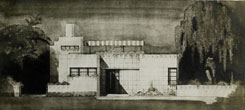
 In late August, our chairman was contacted by the Executive Director of USModernist, an archive dedicated to Modernist residential architecture. He was seeking information on a house believed to be on Mount Avenue in Ealing and designed by architect Bruce Goff, along with others, in the 1930s. The ‘Burton Dunglinson House’ had deteriorated over the years and was rebuilt and heavily altered by a local architect. A vague recollection and some research into our archive newsletters turned up that we do in fact know about this house and had indeed been contacted about it before, in July 2014, by an archivist at the Art Institute of Chicago who asked about the plans for a house in Mount Avenue Ealing apparently designed in 1935 by eminent American architects Alfonso Iannelli and Bruce Goff. The plans had been a mystery to archivists for many years and no one knew whether the house had ever been built. The author of this article investigated the archives at the time. Inspection of the house at the address given did not bear much resemblance to the drawings – the latter showed a flat roof modern movement house set in large grounds with a roof top sun room whereas the existing house has a pitched roof with new houses obscuring the view from the road. Yet certain features, such as the remnants of a curious stepped brick corner chimney stack, were evident. Thanks to the invaluable archive of plans held in the Building Control Department of Ealing Council we were able to discover the original plans of the house as constructed. These were drawn up by a local architect but closely resembled the U.S. plans held in the archive. But why does the current house look so different? It turns out that a previous owner had allowed the original modern movement house to deteriorate to such an extent that it appears that later owners had no option but to re-roof and they decided to extend the property at the same time. Only small clues remain of the existing structure, such as the unusual corner chimney stack. If the original house had survived (see image) it would have been a unique example in this country of the work of an American firm of architects which in their day were as well-known as Frank Lloyd Wright. Robert Gurd


Working to preserve and improve our borough